There was a time when an HIV diagnosis was often viewed as the end of a person’s future. It carried fear, uncertainty, and a stigma that isolated countless people from their families, communities, and even themselves.
Today, medicine has changed.
Science has changed.
But for many people, stigma has not.
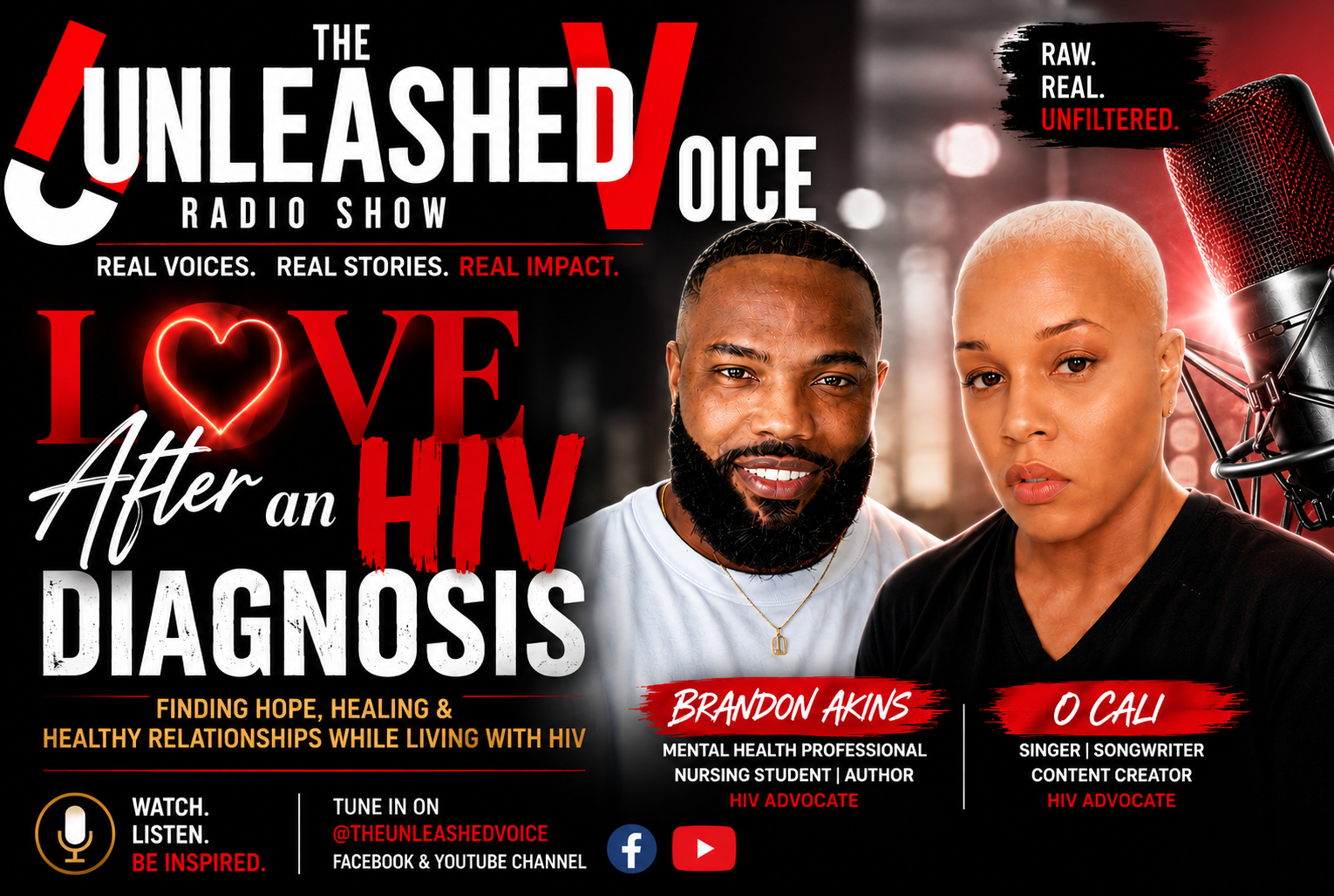
That reality is exactly why The Unleashed Voice Podcast brought together HIV advocates Brandon Akins and O’Cali for an honest conversation about life after diagnosis. Hosted by Gwen GQ, Love After An HIV Diagnosis explores what it means to date, trust, heal, and build meaningful relationships while living with HIV.
Listen to the complete interview on The Unleashed Voice Radio Show / Podcast https://youtu.be/C5BgWAEc3rw
Rather than focusing on the diagnosis itself, the discussion centered on something far more universal: the human desire to love and be loved.
 O’CALI
Born in Freeport, Illinois, and raised primarily in California, O’Cali is a singer-songwriter, independent recording artist, content creator, and HIV/AIDS advocate. After receiving an AIDS diagnosis in 2024, he made a conscious decision that his story would not end there. Instead, he began using music, public speaking, social media, and community outreach to educate others, reduce stigma, encourage HIV testing, and remind people that a diagnosis can become the beginning of purpose rather than despair.
“People living with HIV deserve to be seen as whole people, not as a diagnosis.”
That message echoed throughout the conversation.
Brandon Akins’ path has been equally transformative. Raised between Arkansas and Memphis, Tennessee, Brandon grew up deeply rooted in the church. He became a minister at just 13 years old and was ordained as an Elder by age 15. Many people also recognize him from another chapter of his life, when he was known throughout the gay entertainment industry as BamBam. Today, Brandon embraces every chapter of his journey as part of the person he has become.
Now working in the mental health field while pursuing a nursing degree and writing his first book, Brandon has dedicated his life to helping others heal physically, emotionally, and spiritually.

Brandon Akins
Two Different Journeys. One Common Purpose.
Although Brandon and O’Cali arrived at different places in life, both have transformed personal adversity into public advocacy. Both men have discovered that purpose often grows from pain.
When Life Changes Overnight
One question opened the conversation.
What changed the most after your diagnosis?
For O’Cali, it wasn’t simply his health.
It was how he viewed people, relationships, and life itself.
Instead of allowing HIV to define him, he found a strength he never knew he possessed. The diagnosis forced him to look inward, rebuild his confidence, and choose resilience over fear.
Brandon admitted his experience began differently.
Fear dominated his early days.
Years of stigma and misinformation made him wonder what life would look like moving forward. But over time, therapy, prayer, and self-reflection helped replace fear with peace.
Today, Brandon speaks openly about his diagnosis because he understands that visibility can become someone else’s hope.
Their stories remind us that healing isn’t only physical.
It is emotional.
It is spiritual.
And often, it begins the moment we stop allowing shame to tell our story.
Can Love Survive an HIV Diagnosis?
For both guests, the answer was immediate.
Absolutely.
The key, they agreed, is honesty.
Brandon believes disclosure should happen early in any relationship. While those conversations can feel uncomfortable, he sees them as an opportunity to establish trust and mutual respect from the very beginning.
O’Cali shared that although he has never been someone who dated frequently, he also chose transparency at the start of his current relationship. Being honest about his status allowed trust to grow naturally instead of fear taking control.
Their stories dismantle one of society’s oldest misconceptions: that people living with HIV cannot experience healthy, fulfilling relationships.
Love is still possible.
Intimacy is still possible.
Long-term commitment is still possible.
The diagnosis never changed that.
The Real Enemy Is Misinformation
Throughout the interview, one theme surfaced repeatedly.
Education saves lives.
O’Cali spoke passionately about the importance of helping people understand what it means to be Undetectable = Untransmittable (U=U). Too many people still assume that someone living with HIV is automatically infectious or that being undetectable means the virus has disappeared completely.
Neither belief is true.
Effective treatment allows people living with HIV to suppress the virus to undetectable levels, meaning they cannot sexually transmit HIV to their partners.
He also emphasized the importance of PrEP, a preventive medication that dramatically reduces the risk of acquiring HIV.
Brandon agreed.
He believes communities need more honest conversations about HIV in homes, schools, churches, and healthcare settings. Silence has allowed misinformation to survive for decades.
Both guests also expressed concern over the lack of comprehensive, medically accurate sex education available to many young people. Without access to reliable information, myths continue to shape public opinion.
Their message was simple.
Education replaces fear with facts.
Family, Faith, and Finding Peace
The conversation also explored one of the most personal aspects of an HIV diagnosis: telling family.
Brandon recalled a moment when a relative jokingly wondered whether a mosquito bite could transmit HIV.
While the comment may have seemed harmless, it revealed just how much misinformation still exists.
For Brandon, it reinforced the importance of continuing to educate those closest to us.
O’Cali’s story unfolded differently.
Although his family was supportive, they were not especially close. He waited nearly two years before sharing his diagnosis, wanting first to process his own emotions and avoid unnecessary stress.
When he finally opened up, he found acceptance instead of rejection.
Their experiences illustrate that no two journeys are alike.
But they also demonstrate how education creates understanding where fear once lived.
Turning Pain Into Purpose
Neither Brandon nor O’Cali chose to let HIV become the defining chapter of their lives.
Instead, they transformed it into purpose.
Through music, advocacy, social media, and his lip gloss business, O’Cali continues investing in HIV education while supporting organizations that provide HIV and AIDS services.
Brandon’s passion for helping others has led him deeper into mental health and toward a career in nursing, where he hopes to combine professional care with lived experience.
Their advocacy proves that one story has the power to reach another person who may still be searching for hope.
More Than a Conversation
Before ending the interview, Gwen GQ Clemons challenged viewers to rethink what they believe about HIV.
This conversation was never just about medicine.
It was about dignity.
It was about relationships.
It was about truth.
Most importantly, it was about reminding every person living with HIV that they deserve the same opportunities for love, family, purpose, and happiness as anyone else.
An HIV diagnosis may change a life.
It does not diminish its value.
And as Brandon and O’Cali so powerfully demonstrated, love doesn’t end with a diagnosis. Sometimes, that’s exactly where healing begins.
This work was supported by the 2026 CNP Media Fund #CNPMEDIAFUND