Growing up has never come with an instruction manual.
For today’s young adults, that reality feels even more complicated. Between social media, family expectations, cultural influences, faith traditions, and a constant stream of information online, it can be difficult to know what advice to trust and what beliefs deserve a second look.
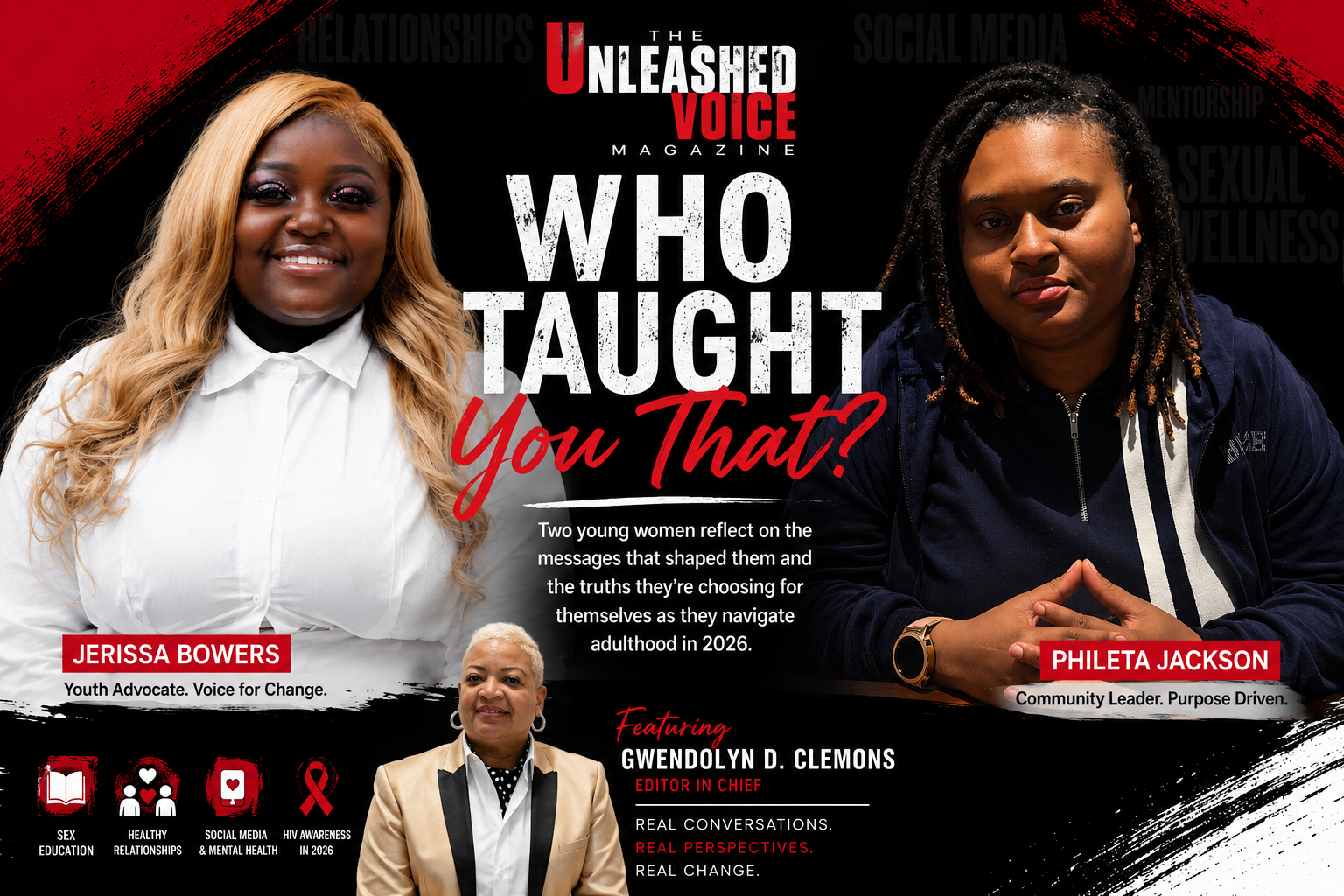
That was the heart of a recent conversation on The Unleashed Voice Podcast’s newest series, Who Taught You That? The discussion brought together young adults between the ages of 18 and 24 to talk openly about sex, relationships, social media, mentorship, and what it means to navigate adulthood in 2026.
Click the link to view the entire Season 10, Ep. 1 Interview
https://www.youtube.com/live/tmZUWKdV-hQ?si=g8jsP0OJBQCyE7Ww
What emerged wasn’t a generation that has all the answers. It was a generation willing to ask deeper questions.
Jerissa Bowers and Phileta Jackson were wise beyond their years. They offer surprising views and knowledge about issues young adults are facing as they navigate their lived experiences in 2026.

Jerissa Bowers

Phileta Jackson
Looking Beyond the Basics of Sex Education
One thing became clear early in the conversation. Many young adults feel like they were taught the mechanics of sex, but not necessarily how to navigate the realities that come with it.
The shared concern was that most of their sex education focused on avoiding pregnancy and sexually transmitted infections. While they agreed those lessons are important, felt they there was little discussion about communication, consent, emotional health, boundaries, or what healthy relationships actually look like.
As a result, many turned to friends, social media, or the internet to fill in the gaps.
The problem is that not everything online is accurate.
Both Jerissa and Phileta agreed that many young people receive information about avoiding pregnancy and sexually transmitted infections, but often receive very little guidance about communication, consent, emotional wellness, boundaries, and healthy relationships.
When those conversations are missing, many young people seek answers elsewhere.
Sometimes that means talking to friends. Other times it means turning to TikTok, Instagram, YouTube, or online influencers.
The challenge, they noted, is that not all information carries the same level of accuracy.
Their conversation highlighted the importance of providing young adults with information that helps them understand not only the physical aspects of sex, but also the emotional and relational realities that come with it.
Healthy decision-making begins with honest information.
Gay Relationships Are About More Than Sex
Another part of the conversation focused on common misconceptions about LGBTQ relationships.
Both participants expressed frustration that discussions about gay relationships often center solely on sex. They pointed out that, just like anyone else, LGBTQ people seek companionship, trust, commitment, emotional connection, and sometimes marriage and family.
One participant noted that people often reduce gay relationships to a stereotype without recognizing the everyday realities that exist within them.
There are disagreements, shared responsibilities, celebrations, heartbreaks, dreams, and long-term commitments. In other words, there are relationships.
The conversation challenged listeners to move beyond assumptions and see LGBTQ relationships through a more complete and human lens.
The Social Media Trap
When the conversation shifted to social media, both guests shared observations that many young adults can relate to.
Social media offers opportunities to connect, learn, and build community. At the same time, it can create pressure to constantly compare yourself to others.
Every day, young people scroll through images of successful careers, expensive vacations, luxury lifestyles, perfect relationships, and major accomplishments.
What often goes unseen are the setbacks, disappointments, failures, and struggles that happen behind the scenes.
Jerissa reflected on how social media can create unrealistic expectations about where people should be in life by a certain age. Phileta added that constant exposure to curated online content can sometimes make people feel like they are falling behind when they are actually progressing at a healthy pace.
Both agreed that social media has contributed to a culture of instant gratification where patience is often undervalued and success is expected to happen overnight.
Real life, however, rarely works that way.
Meaningful growth still takes time.
Why Mentorship Matters
One of the strongest themes to emerge from the conversation was the value of mentorship.
Both guests spoke about the importance of having trusted adults and positive role models who can offer guidance during life’s transitions.
Whether that support comes from a parent, teacher, pastor, community leader, coach, or mentor, having someone who can provide wisdom and perspective can make a tremendous difference.
For LGBTQ youth, mentorship can be especially important.
Finding examples of people who have successfully navigated similar experiences can provide reassurance, hope, and a sense of possibility.
Sometimes young people are not looking for someone to solve every problem.
They simply need someone willing to listen. Someone who understands. Someone who reminds them that they are not alone.
Are Young Adults Still Concerned About HIV?
The conversation also explored how young adults view HIV in 2026.
Unlike previous generations who witnessed the devastating impact of the HIV epidemic firsthand, many young adults have grown up during a time when medical advancements have dramatically changed what living with HIV looks like.
Both Jerissa and Phileta demonstrated awareness of HIV prevention strategies, testing resources, and tools such as PrEP.
At the same time, they acknowledged that HIV does not always carry the same level of fear it once did among younger generations.
That shift presents both opportunities and challenges.
While advances in treatment have reduced fear and stigma for many people, there remains a need for continued education, regular testing, and honest conversations about sexual health.
The discussion made it clear that awareness still matters.
Knowledge still matters.
And access to accurate information remains critical.
Examining What We’ve Been Taught
As the episode came to a close, the title of the series felt more relevant than ever.
Who taught you that?
It’s a simple question, but one that encourages deeper reflection.
Who taught us about relationships?
Who taught us about sex?
Who taught us how to define success?
Who taught us how to view ourselves and others?
For Jerissa and Phileta, adulthood is not simply about learning new things. It is also about examining long-held beliefs and deciding which lessons still serve them and which ones deserve to be challenged.
Their conversation served as a reminder that growth begins with curiosity.
Not every lesson we inherit is wrong.
Not every lesson we inherit is right.
But every lesson is worth examining.
And sometimes the most powerful thing we can do is ask ourselves one simple question:
Who taught you that?
“This work was supported by the 2026 CNP Media Fund.” #CNPMediaFund